


On Sunday morning, I finally watched Babygirl. I first came across it while scrolling through Instagram Reels. There was this one scene that stuck with me—Samuel (the male lead) being told by Romy (the female lead) that he had crossed a line, and Samuel asking her if he really had. That moment lingered in my mind, so I ended up looking up more clips and the trailer. From that point on, I knew I had to watch it someday.
The reason I don’t see this film as merely focused on sex is that every character and plot carries a specific metaphor. In this film, sex is not the main purpose but simply a means of conveying a particular message. The film emphasizes the importance of accepting one’s desires, but even before that, it stresses something more fundamental—the necessity of knowing one’s own desires.
The Duality of Desire and Identity
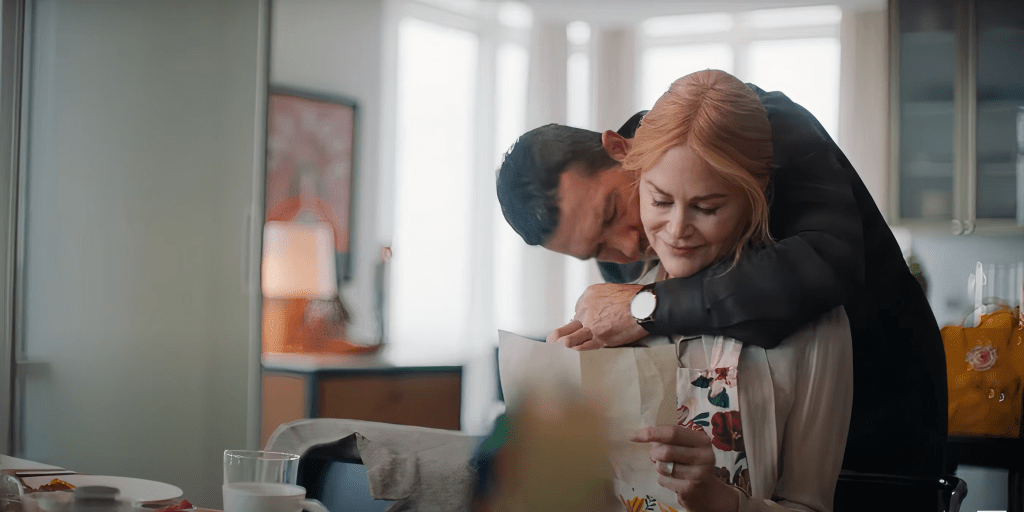
The movie starts with Romy’s loud moans. Based on her reaction during sex with Jacob (her husband), she seems completely satisfied. But as soon as Jacob takes a break, she quietly moves to another room, watches BDSM porn, and reaches climax on her own. She looks relieved afterward, but at the same time, there’s this sense of confusion—like she’s trying to hide from herself what she’s just done.
From there, the film begins to explore Romy’s different roles in life from multiple angles. There’s Romy, the successful CEO giving a speech in front of cameras about next-generation robotics and emotional intelligence. There’s Romy, the mother keeping track of her kids’ daily lives. And then there’s Romy, the wife trying to maintain the image of a perfect spouse. Her meticulously controlled life, which almost seems obsessive, starts to change after a small but unsettling moment—an encounter with a dog on her way to work.
A Chance Encounter and a Test of Control

One morning on her way to work, Romy encounters a loose dog right in front of her office. The leash has snapped, and she freezes in fear, unable to run or react. Just then, Samuel appears and effortlessly takes control of the dog—something no one else had managed to do. This is the first time Romy and Samuel meet.
Desire, Fear, and Control

When Samuel joins Romy’s company as an intern and gets the chance to ask her a question, the first thing he says is: “Do you truly believe in what you’re saying about robotics, or are you just repeating what people want to hear?”
At first glance, this seems like a provocative challenge from Samuel. But on a deeper level, he is actually asking her: “Are you striving for success because you genuinely desire it, or are you simply chasing what others define as success?” Romy is caught off guard and remains silent, unable to answer. Her assistant then steps in and dismisses Samuel from the room. This early scene hints to the audience that what Romy is pursuing may not stem from her true desires.
Later, Romy asks Samuel to bring her coffee and, in passing, inquires how he was able to handle the large dog so effortlessly. Samuel casually responds, “I always carry cookies with me. Want one?” Romy, without hesitation, firmly refuses. This moment invites us to revisit the earlier scene where Samuel subdues the dog.
In the film, Samuel serves as a medium—guiding Romy toward accepting her desires. He himself represents a fantasy. Romy’s deepest longing is to be in a submissive role in her intimate relationships, and Samuel’s ability to control the dog suggests that he is the dominant partner she unconsciously seeks. But if Samuel represents dominance, what does the dog symbolize?
I believe the dog represents Romy herself.
Throughout the film, Romy repeatedly refers to her “dark thoughts.” These thoughts are depicted as having the power to shatter her carefully constructed reality. Several key moments support this interpretation: her unnatural fear when encountering the stray dog, the imagined scene where she is attacked and overpowered by it, and the fact that only Samuel is capable of controlling it. Additionally, the dog’s black color further reinforces the idea that it embodies her dark thoughts.
“We feel fear when we come face-to-face with our own desires.”
A Kiss That Shatters Denial

Later, Samuel approaches Romy and tells her that he has chosen her as his mentor, insisting that they need to have at least one session together. Romy initially refuses, but with little choice, she agrees to meet him as part of the company’s mentorship program. During their meeting, Samuel subtly probes Romy’s hidden desires, pushing boundaries in a way that no one else ever has. At first, she denies everything. But in the end, she kisses him—her first time acknowledging, even to a stranger, the desires she had kept buried for so long.
In this scene, Samuel continuously probes Romy. He asks why she wanted to become a CEO and how it all began. But her answer evades the core of the question. “I had an interview at an investment bank, and they asked me a weird question. I got angry, and somehow, they hired me.” Even in this brief response, it becomes clear once again that she didn’t climb to her position out of personal ambition.
But during their secret meeting, it is Samuel who first voices Romy’s hidden desires. “It seems like you enjoy being told what to do.” Romy is caught off guard, but in the end, she kisses Samuel—finally accepting her desires.
The Price of Desire and the Weight of Reality
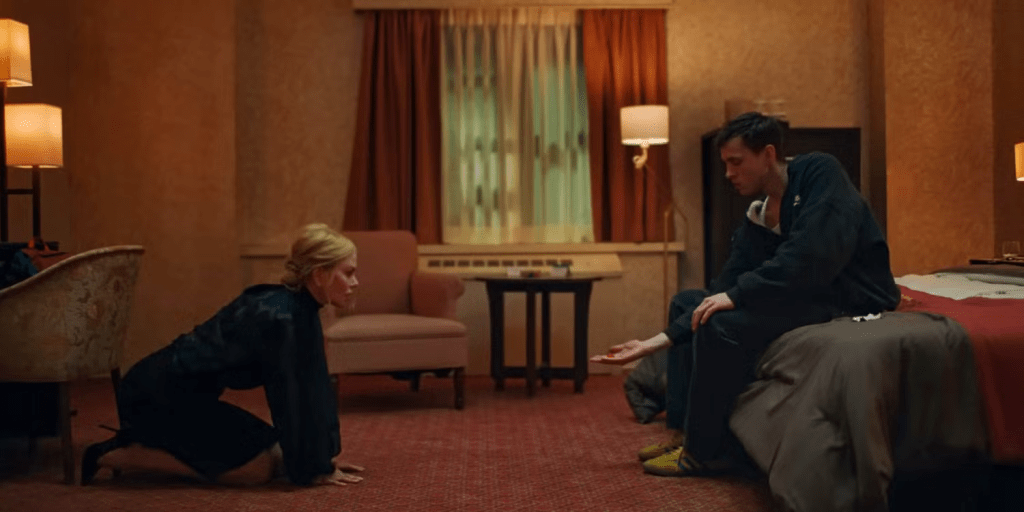
From then on, Romy and Samuel begin meeting in secret—both inside and outside the office—slowly losing themselves in each other. But what makes their relationship so intriguing is that it’s not just about showing SM scenes to the audience. Instead, the film focuses on how Samuel helps Romy articulate what she truly wants. He doesn’t impose his own desires onto her; rather, he persistently asks her what she wants. Throughout their encounters, there are moments where his presence feels less like domination and more like a guiding force—someone drawing out the desires Romy herself had never put into words.
The story unfolds like a series of climaxes and reversals. Their secret affair doesn’t last long. Samuel starts encroaching more and more on Romy’s daily life, and what once felt intoxicating begins to feel suffocating. Romy pulls away, suggesting they stop seeing each other, which enrages Samuel. But then, in the aftermath of their separation, Romy realizes something—she truly does want him. Faced with this truth, she confesses everything to her husband and he kicks her out from the house.
In this film, Jacob symbolizes reality itself—the things we, as adults, are expected to uphold, and the worldview we have carefully constructed over decades, whether we desire it or not. So when Romy confesses what she has done, Jacob responds: “Think about our children. Think about what truly matters. Do you really want to lose everything?” Just like how reality warns us whenever we dare to entertain dark thoughts.
A Rebirth Through Acceptance of Desire

After the separation, Romy lies listlessly in the bedroom of her vacation home, lost in thought. Then, through the window, she notices Samuel swimming in the pool. Then they are drawn back together.
But their reunion is short-lived. When they enter the house, they find Jacob waiting. Tension erupts, and a fight breaks out between Jacob and Samuel. In the middle of it, Jacob suddenly experiences a panic attack. He rejects Romy’s attempts to help him—but surprisingly, he accepts Samuel’s. With Samuel’s guidance, Jacob slowly regains control of his breathing. Then, without a word to anyone, Samuel walks out of the house and leaves.
What intrigued me in this scene was not just why Jacob rejected Romy’s care while accepting Samuel’s, but rather the more crucial question: Jacob rejected Romy, but he did not reject Samuel. Jacob’s panic attack itself symbolizes the collapse of reality. From Romy’s perspective, Jacob is not merely her husband—he represents the very reality she has meticulously built over time. When that reality crumbles, Jacob—reality itself—accepts Samuel, who embodies the unreal, the fantasy. This is the moment when a reality constructed without self-awareness finally embraces the self and is reborn.
After Jacob regains his composure, Samuel leaves the villa without a word. I interpret this as Samuel, having served his purpose as Romy’s fantasy, disappearing from her reality once he has merged with Jacob.
A Reality Shaped by Desire

Later, Romy’s daughter suggests that she return home, father would forgive her, and she agrees to come back home. What follows is a scene of Romy and Jacob having sex—but something is different. Jacob is now wearing a necklace similar to the one Samuel used to wear. His movements, his approach, even his style of intimacy—everything now resembles Samuel. This is because Jacob accepted Samuel.
And then, in the final moment, Romy’s moans fade into the last scene: Samuel, back at the first hotel room where they met, calmly handling a dog. And with that, the film ends. I interpreted this final scene in two ways. The first interpretation is that Romy genuinely finds satisfaction in her intimacy with Jacob. By accepting her desires, she has finally achieved a fulfilling reality. The second interpretation is that the scene represents an ideal fantasy that continues to linger, even within reality. However, considering the overall message of the film, I believe the first interpretation is more likely.
In the end, Babygirl is not a film about sex, but about the silent forces that shape our desires—society, self-perception, and the struggle between control and surrender. It challenges us to ask: Do we shape our reality, or does our reality shape us?

Personally, I enjoy films like this—ones that don’t just end in the theater but leave behind countless thoughts and discussions about their themes. Films where every event, character, and setting blend seamlessly, allowing the audience to naturally uncover the central message without the director explicitly stating it.
There are a few minor shortcomings, so if I were to rate it out of 10, I’d give it an 8. But the way it delivers its core themes is truly refined. There are no unnecessary scenes that feel out of place. A film that skillfully conveys its themes without being overtly explicit stimulates the imagination, making everyday life feel even more vibrant.

 Lighnity